|
Beads
of the Bushman
During a recent tour of South Africa, in April 2004, we stumbled
across the last remaining settlement of the Khoisan Bushmen of
South Africa. It was about ½ hour outside of Kimberly,
Northern Cape, near the town of Barkley West, on the Wildebeest
Kuil and Platfontein Farm, and visitors were welcomed at the
newly constructed Wildebeest Kuil Rock Art Tourist Centre by
members of the !Xue and Khwe tribes, the last remaining community
of San Bushmen in South Africa. They are about 4,000 strong.
The Centre is the Information booth, curio shop and restaurant
of the settlement, and is their sole means of revenue for the
community.
This settlement comes after a long and tragic history of the
San people. Originally brought to extinction by the colonial
Dutch settlers, these remaining Bushmen of the !Xue and Khwe
San community came from Angola and Namibia, where they were tricked
by the Apartheid South African government to help in the war
against the Cubans and the nationalist Angolan government. When
that war ended, the South African government gave the Bushmen
a choice; stay and face the wrath of a hostile Angolan government,
or re-locate to South Africa. The Bushmen, approximately 4,000
strong, were flown to a tent camp inside South Africa where they
lived for seven years, but lost that location to a court ruling
giving the land back to the original indigenous people who had
been displaced by the bushmen, successfully challenging the governments
decision to let the Bushmen live on it.
The new Democratic government at that time, led by Nelson
Mandela, awarded the !Xwe and Khwe community R40 million as compensation
for their treatment under the Apartheid government, and this
money was used to purchase the Wildebeest Kuil and Platfontein
farm which the bushmen live on today.
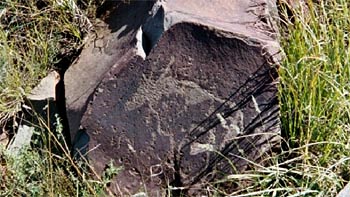 We toured the ancient, 2,000 year
old Bushmen outcropping situated on the top of a small hill,
with its etchings, and purchased crafts the people made in the
local village. Contact was made with the director of the Art
Centre for future business dealings involving beads made by the
local artists using ostrich egg shells. We toured the ancient, 2,000 year
old Bushmen outcropping situated on the top of a small hill,
with its etchings, and purchased crafts the people made in the
local village. Contact was made with the director of the Art
Centre for future business dealings involving beads made by the
local artists using ostrich egg shells.
Rock art at Wildebeest Kuil.
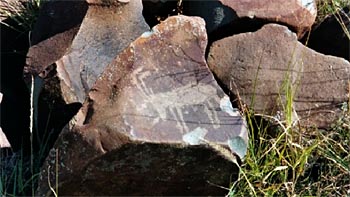
More rock art.
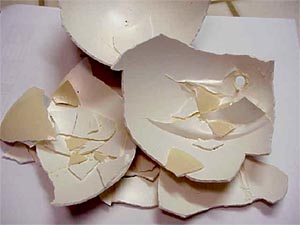
We were able to purchase ostrich egg shell beads made by the
local beadmakers. These primitive beads were made by hand the
traditional way. The ostrich egg shell is broken into small pieces,
then chipped and broken into a disk shape using the teeth to
bite off small pieces of the shell, shaping it into its final
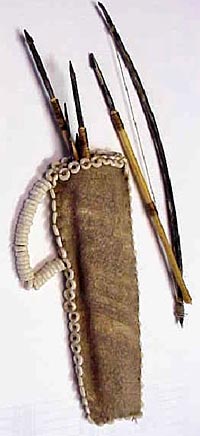
shape. Then using a bow and arrow as a drill, the center hole
is drilled through the shell, creating the bead.
 Broken ostrich
egg shell. Broken ostrich
egg shell.
Bow and arrow used as drill, and beads used as fringe.
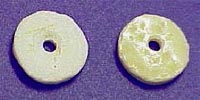
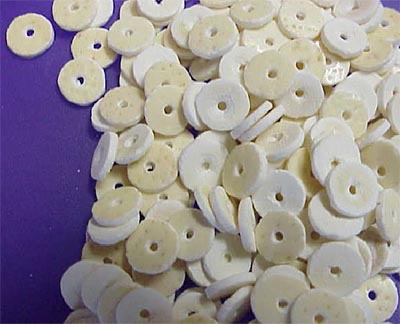
Ostrich egg shell
beads - contemporary.
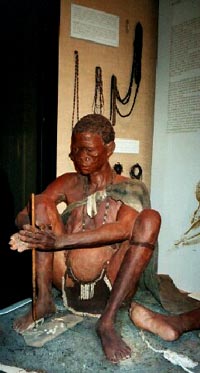
Representation of a Busman drilling beads –Iziko Museum.
Also on display at the Fort in Cape Town(the oldest colonial
building in South Africa, built in 1650, and still in use today
by the military) are the world’s oldest known beads; drilled
sea shells. San Bushmen drilled these beads approximately 75,000
years ago. The beads were discovered in the Blouberg Mountains
of the Cape in 2002.
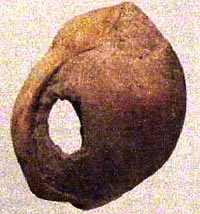
Close up of one of the beads.
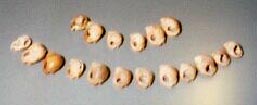
The entire collection on display – Iziko Museum.
For more information on the Wildebeest Kuil Rock Art Site
and the !Xue and Khwe bushmen, visit www.museumsnc.co.za
For more information on the Bushmen of South Africa, visit
the Iziko Museums of Cape Town.
The display of the 75,000 year old beads pictured in this
article are on display at the Castle of Good Hope, courtesy of
the Iziko Museums of Cape Town.
For even more information on Bushmen beadwork, and African
beads in general, visit the Bead Merchants of Africa on Long
Street in Cape Town, owned by Catherine LeSeur. This is the largest
bead shop in South Africa, and Catherine is a wealth of information.
This article was written by Guy and Jamie of Wild Things Beads,
Direct Importers of Czech and German beads and buttons. Guy was
born in colonial Rhodesia, lived in South Africa during the 1970’s,
met and married Jamie in the U.S, and both have traveled since
to Zimbabwe and South Africa several times. Wild Things sold
beads in the Zimbabwe International Trade Fair in the 1990’s,
and in 2004 went on a month long road trip throughout South Africa
and Swaziland, selling beads to bead stores and co-ops.
   |