|
Faceted
Glass Beads - Fire Polish
Posted 7/6/05
Faceting of stone beads has been going on for a long time,
and in Germany faceted beads out of Idar Oberstein are world
known as the best in existence. Glass beads are a more recent
occurrence, relatively speaking, as pressed beads only came into
existence in Gablonz, Austria in 1829, when the first molded
beads were shown at a trade fair in Prague. After that, round
glass beads would have been faceted using the same techniques
as stone faceting in Idar Oberstein. The technicians lay face
down on a bench and pressed the beads onto a stone grinding wheel,
with water running over the stone to keep the dust down. These
early glass faceted beads would have been used in the African
trade market, and can still be found today for sale by African
Traders at the various shows around the country.
These early attempts at faceting were rather primitive, as
glass was not considered very valuable or worthy of much effort
in polishing, as the stone beads were. So, being innovative,
the German bead makers invented firepolishing.
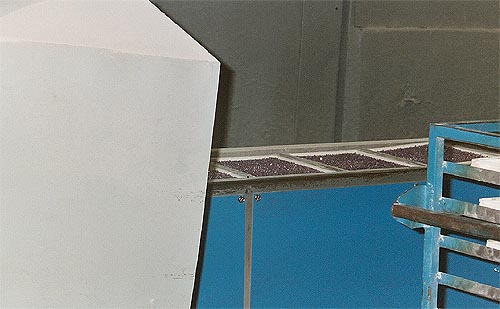 After
the glass bead has been pressed in a mold, and faceted into the
desired amount of cuts, it is run through a heating furnace that
is actually not a flame at all, just an extremely high temperature,
that puts a gloss on the faceted surface of the beads, in effect
polishing it. The machine itself looks like a 20 foot long metal
box, with a conveyor belt running through it. The beads are placed
on metal pie trays, one layer of beads deep, and run through
the heating box. The name firepolish is actually a misnomer,
it should be called heatpolished. After
the glass bead has been pressed in a mold, and faceted into the
desired amount of cuts, it is run through a heating furnace that
is actually not a flame at all, just an extremely high temperature,
that puts a gloss on the faceted surface of the beads, in effect
polishing it. The machine itself looks like a 20 foot long metal
box, with a conveyor belt running through it. The beads are placed
on metal pie trays, one layer of beads deep, and run through
the heating box. The name firepolish is actually a misnomer,
it should be called heatpolished.
Then after they are cooled down, any extra coatings are attached
to them, if required. Examples of different coatings would be
AB, vetrails, pearlized, or bronzing. These coatings would either
be dipped, or sprayed, and then either heated or baked on, or
laquered over, if it is a pearlized coating.
The first firepolish was just your basic transparent and opague
glass, in 3mm, 4mm, 6mm and 8mm round shapes. Currently, round
facetted firepolish comes in those sizes as well as 10mm, 12mm,
14mm, 18mm, 20mm and 22mm. There are also teardrop shapes offered
in 7x5mm, and 9x7mm.
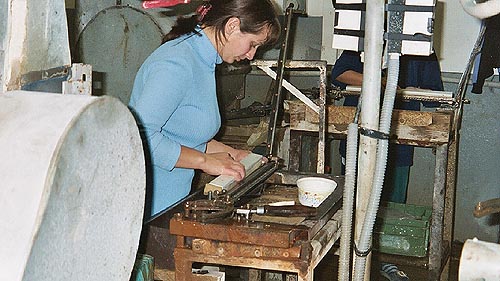 The
technique used today in Czech Republic is basically the same
as in Germany, but now the technician stands up straight in front
of the grinding wheel, which is approximately 8 feet in diameter.
There is a ratchet attached to the wheel, which has an attachable
piece of equipment with multiple holes in a line on it. The technician
scoops this piece of equipment into the bucket of glass beads
at his/her side, and the beads fall part way into the holes.
The technician secures the beads so they wont fall out, attaches
the equipment to the ratchet, and presses it against the revolving
grinding wheel. Water is run over the wheel, and the bead is
ground against the wheel for a few seconds, then released, the
ratchet is applied, the beads turn a little, pressure is again
applied to the wheel on a new section of the bead, and this is
done until the bead is totally faceted all the way around. The
equipment is then unattached from the rachet, the beads dumped
into another bucket, and the procedure is repeated. The room
in which this is done might have up to 20 or more wheels, and
the noise is deafening. The air is hot and moist from the water
and all the machinery running, and is most uncomfortable to be
in for any length of time. The
technique used today in Czech Republic is basically the same
as in Germany, but now the technician stands up straight in front
of the grinding wheel, which is approximately 8 feet in diameter.
There is a ratchet attached to the wheel, which has an attachable
piece of equipment with multiple holes in a line on it. The technician
scoops this piece of equipment into the bucket of glass beads
at his/her side, and the beads fall part way into the holes.
The technician secures the beads so they wont fall out, attaches
the equipment to the ratchet, and presses it against the revolving
grinding wheel. Water is run over the wheel, and the bead is
ground against the wheel for a few seconds, then released, the
ratchet is applied, the beads turn a little, pressure is again
applied to the wheel on a new section of the bead, and this is
done until the bead is totally faceted all the way around. The
equipment is then unattached from the rachet, the beads dumped
into another bucket, and the procedure is repeated. The room
in which this is done might have up to 20 or more wheels, and
the noise is deafening. The air is hot and moist from the water
and all the machinery running, and is most uncomfortable to be
in for any length of time.
Talking to the managers or owners of the different faceting
departments of the firepolish factories, it was brought to my
attention that Czech workers refuse to perform these duties,
and foreign workers from Poland, Slovakia and the Ukraine are
the people who do most of the faceting.
Once the beads are finished being coated, firepolished, inspected,
etc… they are then strung on cotton thread. This can be
done either by machine or by hand. The factories we deal with
farm out the work to people in the local villages who supplement
their income by stringing the beads on a part time basis. The
factory drops off sacks of beads with instructions on how they
are to be strung; ie: 25 beads to a strand, 12 strands to a bundle,
4 bundles to a mass, x number of masses to the sack they are
given. When the job is done, the factory comes back and picks
up the beads, and pays off the workers. Usually it is the women
and children who do this work. If the beads are round, they can
use a machine that looks like a treadle sewing machine, but with
a large bowl on top. The beads are poured into the bowl, and
12 needles are laid into the bowl, which is spun around and beads
get threaded onto the needles and run along miles of thread.
When a large amount of beads are on the thread, the strands are
measured off in the quantity required and tied off.
Some of the factories we use are so small that all the work
is done cottage industry style. The beads are pressed at one
place, by an experienced presser, then it is shipped off to a
faceter, then taken to a larger factory where it is firepolished,
then distributed to the stringers. If a coating needs to be applied,
the beads might then first be sent to a coating facility, then
baked, then strung. If the bead maker is too small to handle
his own exporting, he will then take the beads to a packer, who
will pack the beads, then to an export agent who will prepare
the documents and handle the financing.
When you consider all the steps taken above to produce these
beads, it is amazing really how inexpensive they are to purchase.
They should be much higher.
   |