|
Buttons
- Made in America
Posted 2005
Everything is being mass-produced nowadays, overseas (read
China), and in plastic! Almost the only time you find anything
worthwhile now, it is vintage. During a recent road trip to Connecticut
to do a trunk show at Laura McCabe’s Bead Studio “Just
Let Me Bead”, in Mystic, CT., we were introduced by Laura
to Florence Waxman, who was selling off and closing down the
contents of the Button Box, an antique store that in another
life had been a button factory. It was the end of an era.
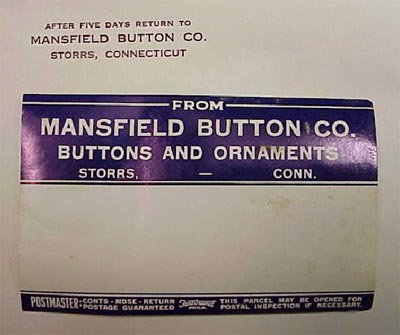 The name of the factory was the
Mansfield Button Factory, in Guylieville, CT. The owners were
Leo and Rita Heinige. Leo had immigrated to the US with his parents
when he was seven years old, from Czechoslovakia, back in the
1920’s. They came from a long line of pearl cutters, producing
buttons in Europe going back 300 years. Leo’s father started
his first button factory in New Jersey, and Leo worked in that
factory, gaining experience until in 1940 he moved to Connecticut
with his young wife Rita who was from Canada, and opened his
own factory in Guylieville, the Mansfield Button Company. The name of the factory was the
Mansfield Button Factory, in Guylieville, CT. The owners were
Leo and Rita Heinige. Leo had immigrated to the US with his parents
when he was seven years old, from Czechoslovakia, back in the
1920’s. They came from a long line of pearl cutters, producing
buttons in Europe going back 300 years. Leo’s father started
his first button factory in New Jersey, and Leo worked in that
factory, gaining experience until in 1940 he moved to Connecticut
with his young wife Rita who was from Canada, and opened his
own factory in Guylieville, the Mansfield Button Company.
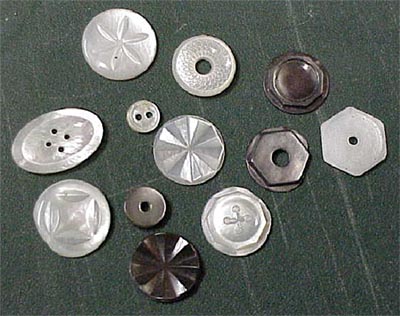
They imported large oyster, abalone and mother of pearl shells
from Indonesia, the Philippines and Australia; which were the
only shells with the proper iridescence needed to be made into
the buttons that were in demand at the time, then cut the shell
into smaller pieces from which cabochons, rings, buttons and
carvings were hand carved. Some of the oysters when cracked open
still had pearls growing inside, and Florence showed us a pair
she was given by Rita to make into jewelry. Florence still hasn’t
done so.
The Heinege’s chose Connecticut because it was close
to the fashion industry that was centered around Providence,
Rhode Island, which was still thriving at the time, although
definitely on the decline. The whole region was sprinkled with
button, bead and thread companies, import houses, and factories.
There were approximately 150 button factories scattered around
the U.S. at the time. Now there are two, one being J. Carucci
& Sons of Lyndhurst, N.J., which does have a family connection
to Leo and Rita Heinege.
The Mansfield Button Company produced huge quantities of shell
buttons, which were very popular and fashionable at that time.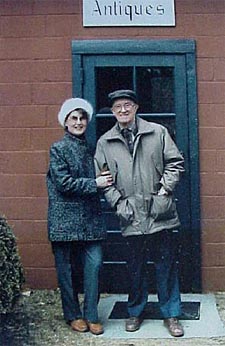
Eventually, though, the popularity of mother of pearl buttons
started to decline, and plastic buttons became all the rage,
and in 1960 the decision was made to close down the factory instead
of investing in the equipment needed to make plastic buttons.
One reason would have been the cost to produce American made
plastic buttons would be much higher than Chinese or Asian costs.
Labor in the region was very organized, as well, and accounted
for many other factories shutting down and relocating to the
south, or even overseas. The Heinege’s decided instead to
convert the factory into an antique store, the Button Box, which
they ran until 1992, when Leo past away.
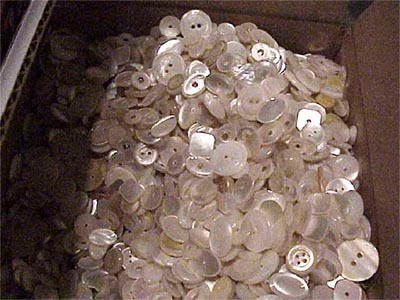 Rita and Leo Rita and Leo
Heinege in front
of the Button Box.
Rita continued to run the store with help from her long time
friend and companion Florence, (whom she had met first as a customer
and then in 1957 joined as an unpaid volunteer), until failing
health in 2003 forced Rita to close the store. Florence has been
selling off the contents, and when we met her in late November
2004, was close to selling the entire building and all the contents
to one customer. We were able to purchase most of the remaining
stock of shell buttons and spacers, cabochons and miscellaneous
jewelry parts of abalone and mother of pearl carvings.
Since the last year of production was 1960, all of the buttons
now in our possession are over 44 years old. Most of the buttons
in our possession are mother of pearl, but also some abalone.
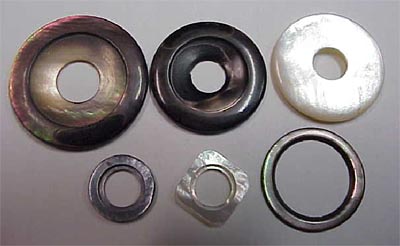
The buttons are mostly clothing buttons, but there are lots
of shoe buttons, and plenty of large rings which can be used
for jewelry.
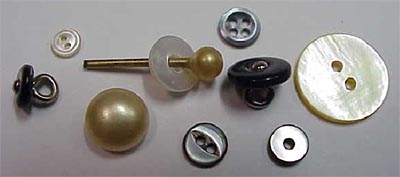
Also many varieties of shell buttons
and sequins in different sizes and colors.
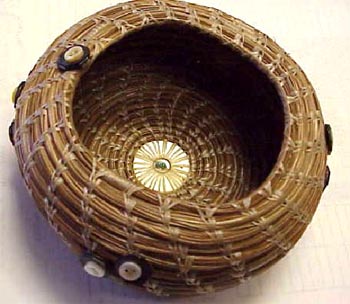
In Quartzsite, Arizona, this year, we offered some of these buttons
for sale, and Patsy Bieser of Mesa, Colorado, purchased quite
a few to incorporate into her pine needle baskets she handmakes.
Patsy has been making pine needle baskets since 1992, and is
self taught.
Pine needle basket – Patsy Bieser.
By the time this article goes to print, the Button Box will
have been sold, and the buttons scattered to various buyers like
ourselves. With the Earth’s rapidly diminishing resources,
large quantities of shell buttons of the quality made by factories
like the Mansfield Button Company probably won’t be made
again, and certainly not in the United States. Like most well
crafted hand made artifacts, they have drifted away in the mists
of time.
Wild Things Beads will be offering these buttons for sale.
Contact us for more information.
   |